Hey all! I’ve been wanting to post for some time, but I’ve been throwing every scrap of available energy into the new book. I didn’t want to disrupt progress until I reached a point where I could park the project for a few weeks and catch up on everything else. So while the engines cool, let’s get right into the details.
What has been happening?
Over the past two years, health has been gradually improving. Occasional relapses make for a jagged graph, but if I take an average, productivity is on the rise. Each half-year has been better than the last. In keeping with the plan described in the previous post, I’ve been working on the science fiction novel exclusively. I am currently busy with version 3, the second rewrite.
The first rewrite was extensive. The rough draft, from years back, was something of an exploratory journey in which I got a feel for things while moving through the new story space. Because I didn’t want to get mired in detail, I left much of that for later and focused on the core of the experience. During the rewrite, that undetailed world needed a complete rebuild, this time with the dials cranked to full on both imagination and research.

One of the things that robs a story of authenticity is a narrative that shows no depth of knowledge in how things actually work. Invented gizmos are great, but if everything is imagination with zero research, it shows pretty quickly. Even a non-scientific reader will start to detect a certain thinness. An avalanche of detail is not the goal, but it’s the textures of known reality that help bring authenticity to a futuristic one (or a fantasy one – something I’ve mentioned before.) This hurdle of solid worldbuilding was the biggest in the process, and it’s now behind me.
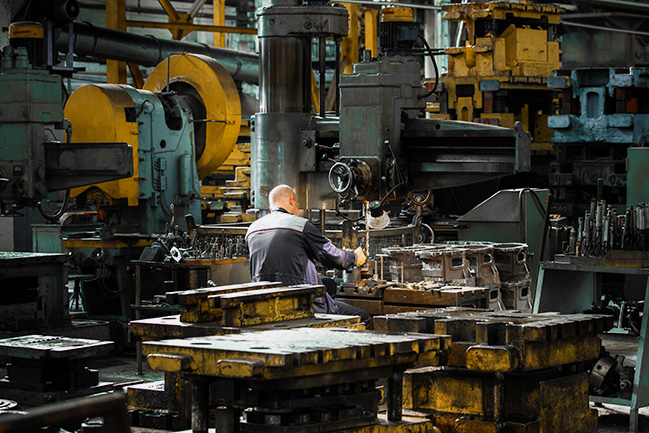
In the second rewrite, the main focus is characters – their motives and relationships. In my experience, it’s easier to write compelling characters when they are placed in an environment that feels real and that demands they interact with it. You get to learn a lot about someone when they fail to hear the four-tone sirens warning of an unearthly creature’s approach, or when they think they are alone on the machine-cluttered factory floor and begin explaining to the drill press everything that is wrong with the world.
How is the science fiction book turning out?
In terms of the reading experience, the story takes place over months, not years, so the pacing is quicker than Dawn of Wonder. This is very definitely an adventure, rather than a coming-of-age story. But one thing I’ve been careful to avoid is the feeling of being hurried to the end and booted off the last page before getting to soak in the new world. Accordingly, there’s now enough space in the story for the reader to wander and explore. I’ve also put a lot into the spaces themselves, building environments that readers – if anything like me – would want to get lost in.
The original ideas in speculative fiction always have their roots in the real world, even if those roots end up being very long and tenuous. Something I’ve been working hard on is trying to capture the awe I felt as a child when the workers were done for the day and nobody was there to stop me clambering over that massive grader – or the more cerebral awe I felt as a physics student when we were taken to a nuclear research facility and looked down into its deep cooling pool, where the eerie blue of the photonic shockwave told of highly radioactive materials – all safely shielded by several metres of water, but daunting nonetheless
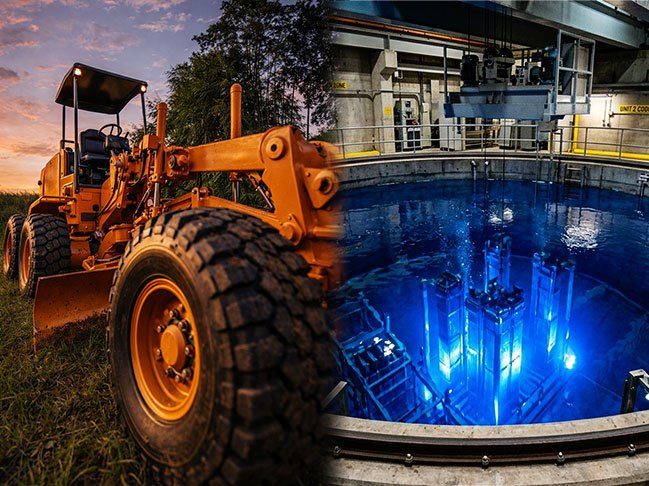
The story I’m writing goes a long way beyond graders and fission-plant cooling tanks, but I’ve never forgotten how experiences like those made me feel, and I work constantly to build a world that will spark in readers something of that same awe that inspired the book.
What is the current plan with The Wakening series?
Though it’s taking longer than anticipated, I’m still on track with what I described in the previous post. The plan is to finish and release the shorter science fiction novel and raise the funds needed to get me through the bigger project of the next Wakening instalment with its higher energy demand and production costs. It’s a stepping-stone approach that makes the crossing feasible. At this point, I’m keeping food on the table and a roof over my head thanks to the unbelievably generous and loyal team of supporters on Patreon, who are, in a very real sense, carrying me across to the next release.
With the sci-fi novel out, I expect to have enough financial relief and breathing space to attack the next book in The Wakening. Given my gradually improving health and productivity, by the time I get there I should have the capacity for the much longer manuscript.

Holding it together and pushing on through chronic illness has required me to run a tighter ship than before. Learning to process disappointment has been vital. I’ll share a little of what I’ve learned in my personal journey in this area, but if you’re only here for progress updates, I completely understand if you want to skip ahead to the last section.
Processing crushed expectations
Disappointed expectations, especially the big and long-term ones, can be devastating. They can tempt us to turn our backs on people, and even on God. The latter has terrible consequences, but in the moment, we can feel cornered by the reasoning – we trust God for something, our hopes are crushed, we conclude he failed us. I’ve heard people address this by suggesting that we forgive God, but even if we overlook the staggering disrespect in that idea, where’s the sense? Any being that needs to be forgiven is not worthy of being called God.
When a healthy life is bent out of shape by any form of trial or tragedy, it’s easy to look heavenward and entertain words like “failed” or “betrayed”. In these times, I’ve found it valuable to acknowledge the feeling, but then ask the question, what were the steps that led me to feel this way? If I dig enough, and if I’m honest enough, the answer is almost always poorly founded expectations.

Here’s a quick example. Even if you haven’t read the bible, you may have heard the words, “I know the plans I have for you, plans to prosper and not to harm you, plans to give you a hope and a future.” If you don’t read the rest of the chapter, it would be easy to conclude something like this: If God’s plan is about my prosperity, and my plans are also about my prosperity, it must mean he agrees with my plans and intends to support them. But anyone who does read the rest of the chapter will see that this is not at all what God is saying through Jeremiah. The point being made could be paraphrased as, “The plans I have for you, which will lead to your good, require you to give up your plans.” An expectation built on the first interpretation, the misinterpretation rinsed of context, is guaranteed to fail, because it was never promised to us.
Processing crushed expectations through years of chronic illness wasn’t about venting emotions; it was about having a deep and honest look at the basis of each failed expectation and acknowledging my own misinterpretations. This completely changed the emotions.
There are passages in the Bible that speak of God healing us and passages that describe how God uses suffering for good in our lives. Different things at different times for different purposes. So while I have not yet been fully healed, I still believe God heals, and I will continue to ask for healing. But I also recognise that, while he welcomes our requests, no prayer compels God to do our will, and he may well have reason to say no, or not yet. For many of us, though, that raises a question:
What value could there be in suffering?
Many books have been written on this. For the most part, big questions can’t be answered in a few words, so I won’t attempt to tackle the topic in a general sense. I’ll just mention two areas where I’ve seen purpose in recent times.
The best of treasures
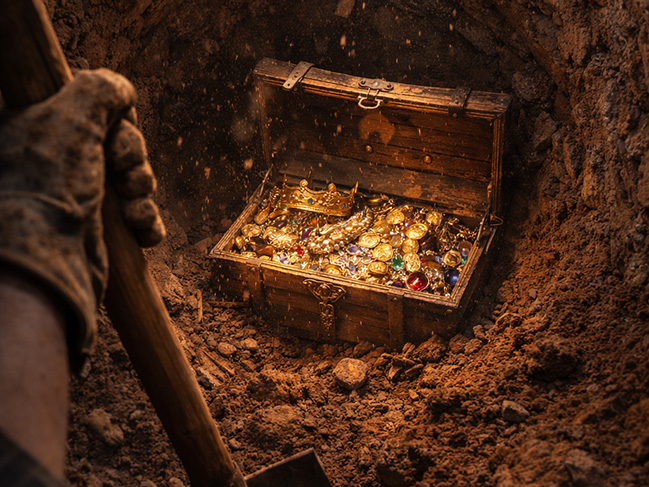
This is something I’ve touched on before, but it’s so foundational that I don’t think I could leave it out here. Have you ever noticed how people reach for God with more of themselves – more time, more energy, more intentionality – when in need? Writers have commented on this from ancient times. In questioning the purpose of trials, a thought struck. If thirst moves us to dig a well that yields not only water but a buried treasure, who would complain against the thirst? My trials certainly resulted in a treasure trove of intimacy with God because of my desperation. Not even the sum total of everything I lost comes close to this in worth.
Pursuing God might begin from needy or even selfish motivations, but we become like whatever our eyes are fixed on. Our treasure has a way of shaping our hearts. If we grow to love God – his greatest command – then the closeness that follows will shape our hearts to be more like his, and we will find ourselves wanting to fulfil what Jesus described as the second greatest command – to love people. Loving God might require sacrifice, but it is no loss. We are the ones who gain the most in the relationship. It is very much for our own good, and it directly leads to the good of those around us.
Character

Breakthrough is often thought of as overcoming something that opposes us, but few things oppose or limit us like aspects of character – our own natures. Character never grows much when life is running smoothly, just as muscles don’t grow when they have nothing to oppose them. But when the pressure is unbearable and we resist the urge to take it out on others, or to turn to poisonous comforts, or even just to retreat from life and give in – those are times of personal breakthrough. Just as character is revealed in the struggle, it also has the chance to grow there.
In this sense, breakthrough is not the end of a trial – breakthrough is what happens during the trial as it begins to accomplish what it was meant to. Here we grow into things like a deeper trust, a sturdier faith, humility in place of pride, intimacy in place of autonomy, or a more complete surrender – these are huge conquests.
I don’t think it’s ever wrong to ask for healing or deliverance from something deeply difficult or painful, but I’ve found that we can lose out on the opportunity for growth – we can miss the good that God intends for us – if we refuse to accept that difficult times can have valuable purposes in our lives.
Back to the hangar
To everyone who’s dropped in here, thank you for sticking around through this time of illness. I hope your patience will be rewarded before too much longer and that I’ll be able to give you a book worth the wait.
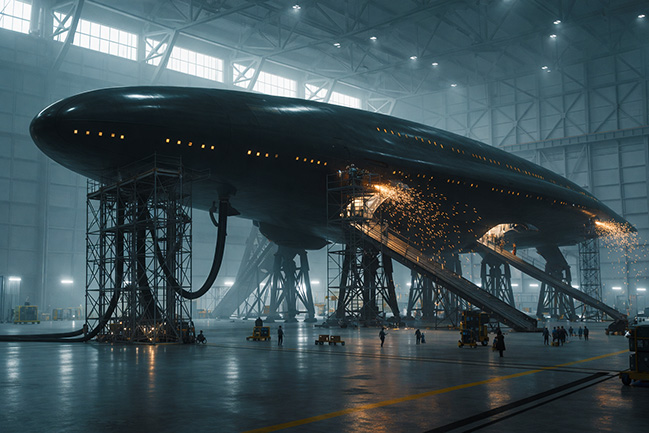
I’m not one for text reveals (because of how much the text changes through the rewrites), but I can give you another visual book peek. It helps me sometimes to put together visuals of the scenes I’ve written. This one gives a pretty good idea of the craft that will launch our intrepid crew on their adventure. I hope you like it – your berths are being prepared.